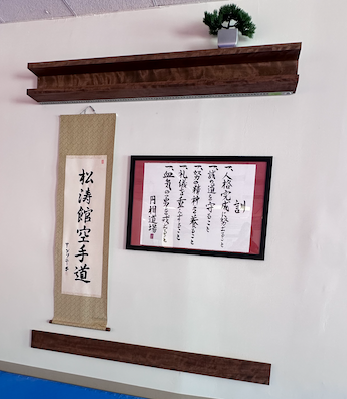
Dojo Kun
Gichin Funakoshi developed the dojo kun, or dojo philosophy, which are the principles that guide our karate practice. At every class, the dojo kun reminds us of what we should strive for inside and outside the dojo. In other words, what we learn from karate should be made a part of our daily lives. These are the ideas that provide the moral foundation for karate:
Seek perfection of character
Be faithful
Endeavor
Respect others
Refrain from violent behavior
CHARACTER: Seek perfection of character. This principle of the dojo kun means that Karate-do is an art of people of high character. Perfecting our character is something we can always continue to do. We work to build character by continually challenging ourselves, physically and mentally. We train to fight to develop not only powerful techniques and the ability to defend ourselves, but also to develop the spirit and mental balance needed to overcome any difficulty. Gichin Funakoshi stressed that working to perfect character is of ultimate importance.
The challenges you experience in karate can help you improve and become a better person. How can you improve your character? How do you show kindness, patience, humility, and respect in and out of the dojo?
SINCERITY: Be faithful. This principle is about being honest, and having a sincere intention to learn and to improve. It is important to have trust and loyalty for your instructors and fellow students. Being sincere and serious is also essential during training. Without it, training situations could easily lead to injury. Also, since you will be put in mentally challenging and physically demanding and stressful situations, having trust in your instructors will help you face this.
Are you dedicated to practicing and improving yourself? Have you shown your teachers that you are committed to training? Do you train with a serious attitude?
EFFORT: Endeavor. To endeavor means to put 100% effort into everything you do. This principle is about developing a spirit of effort in the face of difficulty. Sincerity, dedication, perseverance, patience, and commitment are necessary to master karate, or anything, in life.
How have you faced challenges in and out of the dojo? What do you do when you feel like giving up? Do you attend classes regularly?
ETIQUETTE: Respect others. Without respect and good manners, there is no karate. We should extend respect to all including teachers, fellow students, parents, the dojo, our community, etc. One main way we see this respect in the dojo is in the way we bow to each other. This shows that we are participating in training with the correct attitude — an attitude of respect for our fellow students and teachers, not an attitude of learning to inflict harm on others. The rules of etiquette are essential to maintaining an atmosphere of respect and developing an awareness of your behavior that helps you avoid dangerous situations.
Do you know and follow the rules of etiquette in our dojo? Do you treat fellow students, teachers, and parents with respect? Do you help new students learn the rules of etiquette?
CONTROL: Refrain from violent behavior. In karate, we train to develop strong and devastating attacks, as well as fast reactions and defensive techniques. We also train to develop a fighting spirit. All of these should not be used for unjust causes. We should develop the self-control needed to avoid violent encounters and other confrontations. This is the idea of winning without fighting.
Do you show off your karate techniques outside of training in a way that might invite trouble? Do you avoid getting into bad situations? Can you control your temper? Do you know how to calm and settle your mind in a stressful situation? Do you practice with the right, positive attitude?
Gichin Funakoshi’s Twenty Precepts
Sensei Funakoshi wrote the twenty precepts to help students make karate a way of life. English translations vary. These were meant to provoke thinking about the application of karate to everyday living.
- Karate is not only dojo training.
- Don’t forget that karate begins with a bow and ends with a bow.
- In karate, never attack first.
- One who practices karate must follow the way of justice.
- First you must know yourself. Then you can know others.
- Spiritual development is paramount; technical skills are merely means to the end.
- You must release your mind.
- Misfortune comes out of laziness.
- Karate is a lifelong training.
- Put karate into everything you do.
- Karate is like hot water. If you do not give it heat constantly, it will again become cold.
- Do not think you have to win. Think that you do not have to lose.
- Victory depends on your ability to tell vulnerable points from invulnerable ones.
- Move according to your opponent.
- Consider your opponent’s hands and legs as you would sharp swords.
- When you leave home, think that millions of opponents are waiting for you.
- Ready position for beginners and natural position for advanced students.
- Kata is one thing. Engaging in a real fight is another.
- Do not forget (1) strength and weakness of power, (2) expansion and contraction of the body, and (3) slowness and speed of techniques.
- Devise at all times.